
Presenting
Eye contact with your audience: how to tell if your story is landing
ByJerre Maas · · last updated · 3min read
Eye contact when presenting is not a trick for dealing with nerves. It is how you tell whether your message is getting through. Here is how to do it with a small group and in a large auditorium.
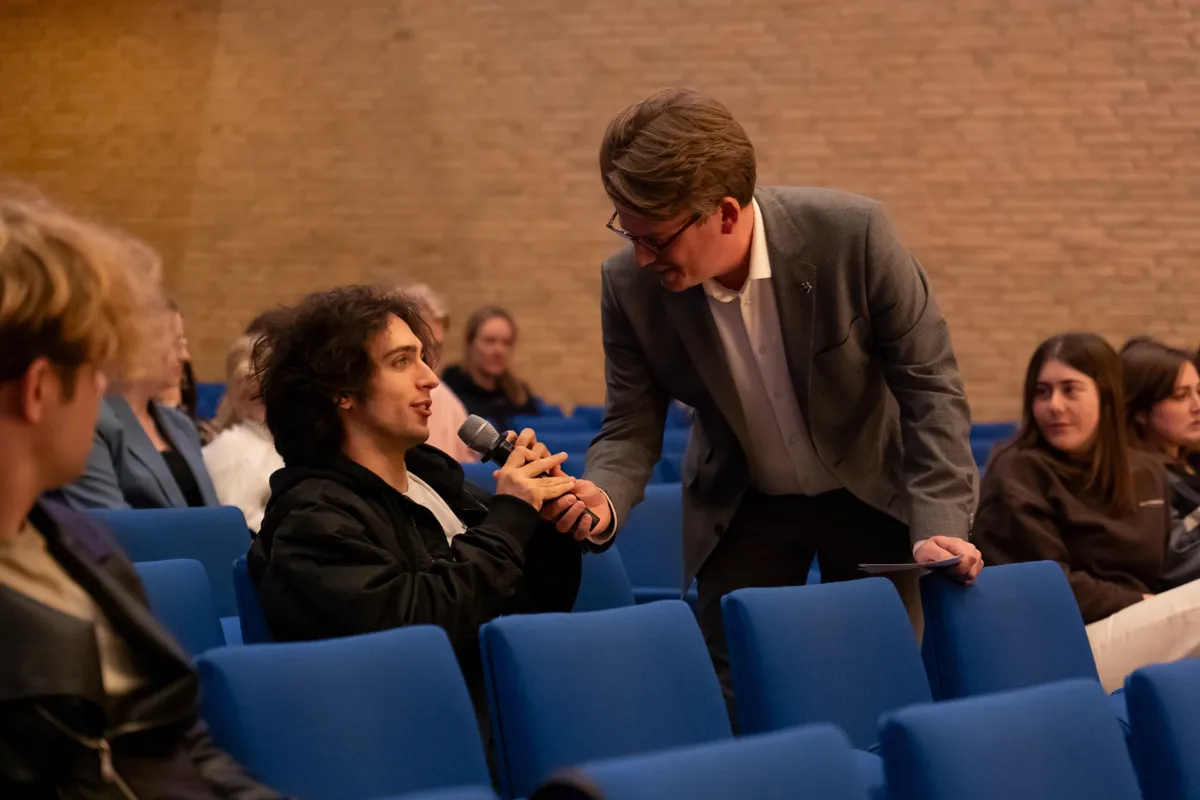
Some coaches advise speakers to look over the audience’s heads. That way, you cannot see their faces, which is supposed to help with nerves. I think that is bad advice. The most important thing in a presentation is genuine contact between the speaker and the audience. Eye contact is the most important way to make that happen, and anyone who avoids it is effectively presenting to a wall.
Communication goes both ways
Communication involves sending and receiving. Most speakers spend almost all their preparation time on sending. Which words should I choose, in what order, and which slide? Receiving gets hardly any attention, even though it is just as important.
By looking at people, you can see whether your message is getting through. Are they frowning, nodding, looking at their phones? That is information you can use straight away. You can add an example, take a step back or move more quickly through a section everyone already knows.
The common mistake
The mistake I see most often is not that speakers fail to look at anyone at all. It is that they keep looking at the same person. Usually someone in the front row who is nodding encouragingly. Understandable, because it feels safe. But the rest of the audience switches off, and that one person feels uncomfortable after ten minutes.
Small group, large auditorium
In a small group, you make contact with everyone. Once there are around fifty people, that is no longer possible. Then you work with fixed points.
- Choose a few people spread across the room: left, centre and right, both near the front and at the back.
- Share a thought or a sentence with one of them, then move to another point for your next thought.
- Use those people as a barometer. If you see confusion on their faces, there is a good chance others are struggling to follow too.
- Also make a point of looking at the back rows now and then. People there are often the first to switch off.
A welcome side effect is that the whole room feels as though you are looking at them. Even the back row.
Just a conversation
It is about normal eye contact, the kind you make in a conversation. Do not stare, and do not tick off the room like a list. Look at the people and tell them your story. A presentation is ultimately a conversation with lots of people at once. It is not a performance you have learnt by heart and deliver regardless of what is happening in the room.
Unsure? Just ask
If you see confused faces, ask whether it is clear. They will not bite, usually. A short question such as “Are you still with me?” takes five seconds and often gives you the best minute of your presentation.
What this means for the organiser
Eye contact requires light in the room. At many events, the stage is brightly lit while the audience sits in the dark. The speaker can no longer see anyone. Ask the technical team not to darken the room completely, especially when a chair or moderator needs to respond to the audience. Those roles only work if they can see what is happening. In the article about the differences between the roles, you can read why.
For the speaker without a big name
A client booking an unknown speaker often wants someone who makes genuine contact rather than simply delivering a talk. Eye contact is the simplest way to show that. It costs nothing, you can practise it, and you can see the difference in the questions you get afterwards.
Frequently asked questions
- Is looking over the audience’s heads good advice for dealing with nerves?
- No. You miss all the signals from the audience. Instead, look at a few friendly faces spread across the room and build from there.
- How do you make eye contact in a large auditorium?
- Choose fixed points on the left, in the centre and on the right, both near the front and at the back. Share each thought with one point, then move on to the next.
- What should I do if I see confused faces?
- Briefly ask whether it is clear. It takes a few seconds and stops the audience from losing track of the rest of your story.
An earlier version of this article was published onjerremaas.nl. Oorspronkelijk verschenen op Presensatie.nl (2014). Herschreven in 2026.
Read more
9 October 2026
· Jerre MaasPresentingHolding your audience’s attention during a presentation
Holding an audience’s attention during a presentation takes variety, not tricks. Here’s how I switch between doing, watching, talking and quiet reflection.
4 min read
27 September 2026
· Jerre MaasPresentingMehrabian’s 7-38-55 rule: what it really says
Mehrabian’s 7-38-55 rule doesn’t say that words hardly matter. Here’s what the research did show, and what you can take from it as a speaker.
3 min read
23 September 2026
· Jerre MaasPresentingSlides in your presentation: a tool, not a script
Making slides for a presentation? Start with your story. Why your presentation, your tool and your handout are three different things, each with its own purpose.
3 min read
Speakers who talk about this

Cas de Morree
Laten we stoppen met de onzin die we werk zijn gaan noemen.
Presents in English and Dutch
Across the Netherlands · Speak, Engage · Collaboration and team development, Personal growth
From € 1,950 per half-day, excluding VAT

Jan Bellemakers
Jan begeleidt op een creatieve manier sessies, helpt teams in hun ontwikkeling en maakt van bijeenkomsten een gezellig succes.
Presents in Dutch
North Brabant · Host, Engage · Collaboration and team development, Creativity
From € 450 per half-day, excluding VAT

Debbie Been | Slimmer dan je smartphoneWith a pitch video
Voor meer grip op je schermgebruik moet je aan de bak met ongemak
Presents in Dutch
North Holland · Speak, Engage · Attention, Attention in the Workplace
From € 1,950 per day, excluding VAT