Interactie
Interaction in your presentation: when to use it and when not to
ByJerre Maas · · last updated · 3min read
Interaction in a presentation only works if you do something with the outcome. A look at token interaction, and when it is better to let the audience simply listen.
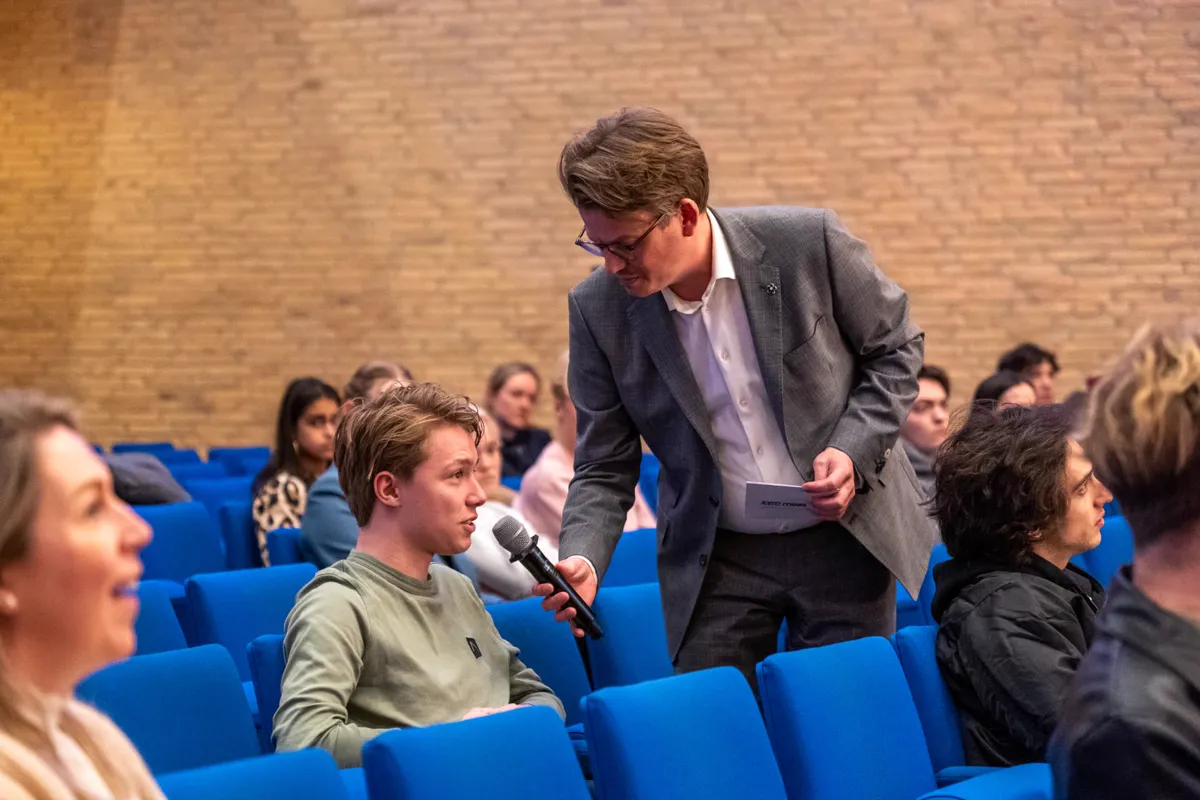
"Could you come and give a talk? But we'd like it to be a bit interactive." I hear that line in almost every enquiry. Taking part seems to have become the norm. The audience has to do something, even if it adds nothing to the story.
It might seem strange that I of all people am critical of this. Interaction is my line of work. I've been building tools for it for years, and sometimes I literally give the audience the remote control for my presentation. That's precisely why I know how often it goes wrong. Interaction is a means to an end. Make it an end in itself, and you get an audience that dutifully joins in but gets nothing out of it.
What I mean by interaction
A presentation without interaction doesn't really exist. As soon as there are people in the room, they respond to you, with or without words. They laugh, frown and reach for their phones. You only truly present without interaction when you're speaking to a camera or a wall.
When I talk about interaction here, I mean audience participation. Asking questions, talking to one another, voting, doing an exercise or taking on a role in the story.
The pitfall: token interaction
Many gurus say you should do something with your audience every few minutes. This leads to what I call token interaction. Interaction for its own sake. A forced exercise, or a statement that serves only as a link to the next slide.
You know the sort of thing. People choose a side, the speaker says, "Great, now we know that," and carries on with their talk. They're not genuinely interested in what the audience thinks. The audience can tell, and next time they'll be a little less keen to take part.
When it works
I use interaction to clarify something, create an aha moment or give my message more weight. Here are a few examples.
- When I want to show how divided an audience is, and then genuinely build on that.
- When the knowledge in the room is greater than the knowledge on stage.
- When people need to do something afterwards, and I let them practise it in advance.
In all three cases, the outcome changes what happens next. That's the test.
When it's better to leave it out
In a pitch or a strong argument, interaction can be a distraction. You're building a case, then interrupting it halfway through for a poll. You can do that, but think carefully about why. Sometimes the best thing you can give an audience is twenty minutes of listening to someone who has something to say.
A simple approach
- For each interactive moment, write down what you want to find out or achieve.
- Decide in advance what you'll do with each possible outcome. What will you say if the audience agrees with you, and what if they disagree?
- Allow time to respond to the outcome. A vote without discussion is a missed opportunity.
- Cut any moment when you don't know the answer to question 1.
What this means for the client
As an organiser, don't ask, "Can you make it interactive?" Ask, "What should the audience know or do afterwards?" The speaker or facilitator can then decide whether interaction will help. At an event with lots of programme items, a chair makes sure the audience isn't given another poll at every session. To find out which role suits your event, see the differences between the roles.
For speakers who want to stand out
As a less well-known speaker, you're often asked because an organiser wants something other than the standard talk. Interaction can be tempting as a calling card. But what really sets you apart is showing that you listen to what the audience says. One vote that you respond to sincerely does more than five that you simply tick off.
So here's my brief advice to organisers and speakers. At every interactive moment, ask yourself what you'll do with the outcome. If the answer is "nothing", leave it out.
Frequently asked questions
- Does a presentation always have to be interactive?
- No. Interaction is a means to an end. In a pitch or a strong argument, it can be a distraction. Use it only if the outcome changes what happens next.
- What is token interaction?
- Interaction for its own sake: a statement or exercise whose outcome the speaker does nothing with. The audience notices, and is then less keen to take part.
- How do I ask for an interactive session as an organiser?
- Don't ask whether it can be interactive. Ask what the audience should know or do afterwards. The speaker or facilitator can then decide whether interaction will help.
An earlier version of this article was published onjerremaas.nl. Oorspronkelijk verschenen op Presensatie.nl (2016). Herschreven in 2026.
Read more
19 September 2026
· Jerre MaasInteractieThe paper-ball Q&A: asking questions anonymously without technology
With the paper-ball Q&A, an audience can ask questions anonymously using only paper and a pen. Here’s how this format works and how to use it in your own session.
3 min read
9 October 2026
· Jerre MaasPresentingHolding your audience’s attention during a presentation
Holding an audience’s attention during a presentation takes variety, not tricks. Here’s how I switch between doing, watching, talking and quiet reflection.
4 min read
1 October 2026
· Jerre MaasPresentingEye contact with your audience: how to tell if your story is landing
Eye contact when presenting is not a trick for dealing with nerves. It is how you tell whether your message is getting through. Here is how to do it with a small group and in a large auditorium.
3 min read
Speakers who talk about this

Jan Bellemakers
Jan begeleidt op een creatieve manier sessies, helpt teams in hun ontwikkeling en maakt van bijeenkomsten een gezellig succes.
Presents in Dutch
North Brabant · Host, Engage · Collaboration and team development, Creativity
From € 450 per half-day, excluding VAT

Alison Sof
Integratief therapeut, coach en spreker
Presents in Dutch
South Holland · Speak, Host, Engage · Personal growth, Health and vitality
From € 500 per half-day, excluding VAT

Cas de Morree
Laten we stoppen met de onzin die we werk zijn gaan noemen.
Presents in English and Dutch
Across the Netherlands · Speak, Engage · Collaboration and team development, Personal growth
From € 1,950 per half-day, excluding VAT